The Crescent and the Block: Where UKIP's MEPs Sat in the Strasbourg Hemicycle
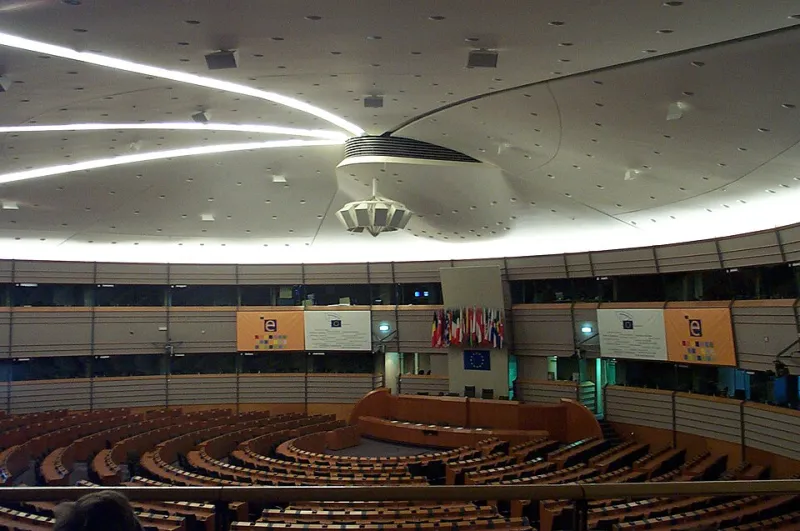
Photo: Unknown, CC BY 2.5, via Wikimedia Commons
The European Parliament does not seat members by nationality. It seats them by political group. That simple rule makes the hemicycle one of the most revealing documents in the UKIP MEP archive. Between 2014 and 2020, the party's MEPs were not merely a list of names in a register; they were a block of desks in a crescent, placed beside allies, rivals and the unaligned. Reconstructing that geography from seating plans, photographs and contemporaneous accounts offers a different view of UKIP's European years: less a story of speeches than of proximity.
The crescent as a political map
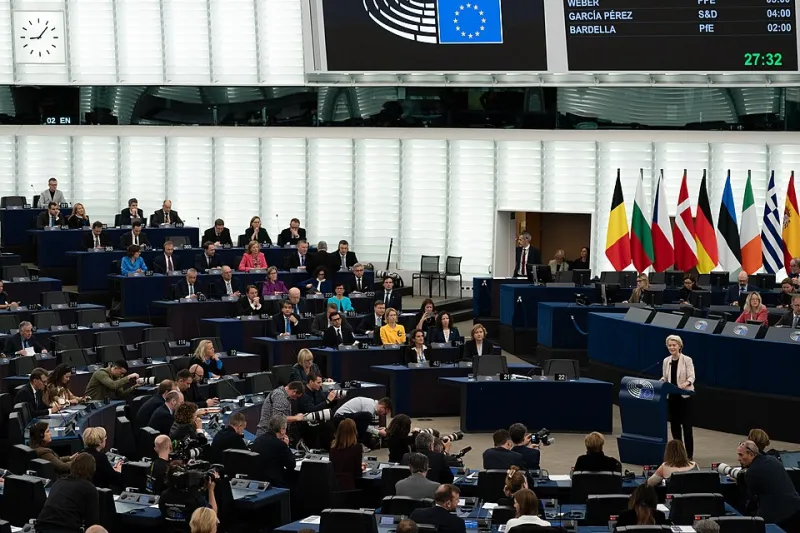
The chamber runs from left to right in the familiar hemicycle formation. Groups occupy defined blocks, and within those blocks national delegations tend to cluster. The 2014 intake of 24 UKIP MEPs entered as the largest national contingent within the Europe of Freedom and Direct Democracy group. In the official seating plan, EFDD occupied a block on the right of the chamber, beside the European Conservatives and Reformists and, later, the Europe of Nations and Freedom. Non-attached members were scattered around the edges.
For UKIP, the block mattered. Photographs from the opening session show the party's members grouped tightly enough to read as a single contingent. The image was one of weight: a party that had topped the UK poll in 2014 could point to a solid row of seats as evidence that it had arrived in Brussels and Strasbourg as a force, not a curiosity.
Neighbours and signals
Placement beside EFDD allies such as Five Star and the Sweden Democrats was not an accident of alphabet. The group was a coalition of convenience, assembled from parties with different domestic agendas but a shared suspicion of the EU's direction. UKIP's MEPs sat within that coalition, close enough to be associated with it and far enough from the mainstream groups to make the association plain.
The geography also exposed the limits of the alliance. EFDD was not a party with a whipping system of the kind that operates in national parliaments. Its members disagreed on economic policy, foreign affairs and civil liberties. A seat beside an EFDD colleague was therefore a statement about group membership, not a guarantee of common voting behaviour. The archive's photographs show UKIP members in the front rows of the EFDD block, but the roll-call records show a group that often fractured when the subject moved away from EU membership.
Ruptures and reseating
Group ruptures had physical consequences. When MEPs left UKIP or the group, they moved seats. The hemicycle's seating plan is reissued when groups change, and the archive holds plans from different stages of the term that show the EFDD block shrinking. By the end of the Parliament, the block was smaller and less cohesive. Some former UKIP members sat as non-attached members, often at the rear or along the edges of the chamber, where the eye is less likely to fall.
That movement is part of the party's history. Defections and departures are usually recorded in membership lists and press releases. They are less often recorded in the furniture of the chamber. Yet the seating plan makes the same point in visual form: a party that had once occupied a substantial block was reduced to gaps and isolated desks.
After 2019
UKIP returned no MEPs in 2019. The Brexit Party's MEPs, many of them former UKIP figures, sat initially as non-attached members, outside the established group blocks. The crescent changed again. For the archive, the contrast is instructive. UKIP's peak was visible not only in vote share but in a solid row of seats. Its end was visible in the spaces left behind.
Seating is not a trivial detail. In a chamber that organises itself by political group, where you sit is a statement about who you are willing to be counted with. For UKIP's MEPs, the answer changed across the term. The archive's seating file is therefore more than a curiosity. It is a map of the party's alliances, its isolation and its slow contraction.