The Other Division Lists: UKIP's MEPs on Climate, Trade and Civil Liberties
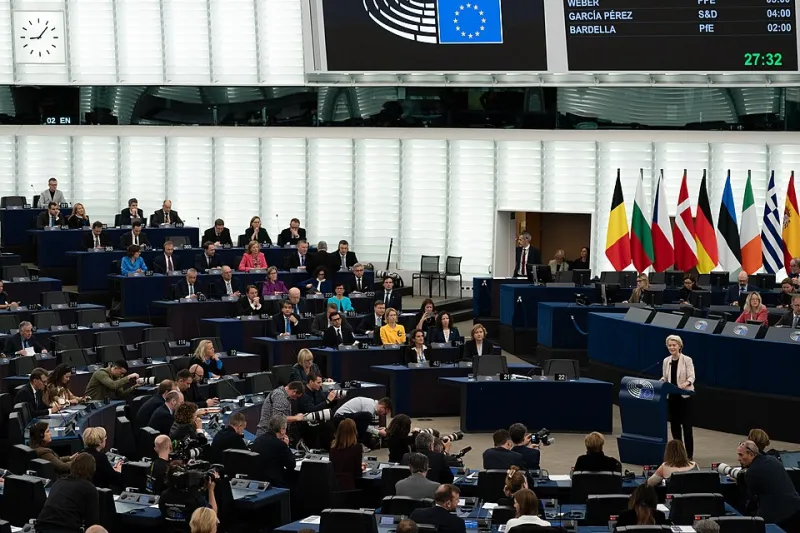
Photo: European Parliament, CC BY 2.0, via Wikimedia Commons
The roll-call record is the archive's most underused source. UKIP's MEPs are remembered for one vote above all: the vote to leave the EU. But the European Parliament voted on hundreds of items during the 2014–2019 term, from emissions trading to trade consent motions, from data retention to sanctions on Russia. Those division lists show what UKIP's MEPs did when the headline question of membership was absent.
Method and limits
This analysis draws on the archive's working dataset of recorded votes from the 2014–2019 Parliament, coded by policy domain and compared with the EFDD group and the chamber as a whole. Roll-call votes are a subset of all votes. They are requested by groups, often on contested or symbolic items, and they do not capture consensus. They are nevertheless the best available record of individual behaviour, and they allow patterns to be identified across the UKIP cohort.
Environment and energy
The clearest pattern is on climate and energy. UKIP MEPs were more likely than the chamber average to oppose binding EU climate targets, reforms to the emissions trading system and resolutions declaring a climate emergency. They were also more likely to support nuclear energy and to resist EU-level subsidies for renewable generation. This was not absence from the debate. It was a consistent preference for national energy mixes and what the party called technological neutrality.
The pattern had contradictions. UKIP MEPs could support measures on energy security and criticise dependence on Russian gas while opposing a common EU energy policy. The sovereigntist logic pointed in two directions: towards national control and towards a harder line on external suppliers. The division lists record both.
Trade
On trade, the record is less libertarian than the party's rhetoric might suggest. UKIP MEPs often opposed or abstained on consent motions for EU trade agreements. That was not necessarily protectionism. It followed from the party's objection to the EU's exclusive competence in trade policy. UKIP could support free trade in principle while refusing to endorse a treaty that, in its view, transferred authority to Brussels.
The comparison with EFDD allies is revealing. Some EFDD members opposed trade deals on protectionist or environmental grounds. UKIP's objections were more often constitutional. The votes sometimes coincided, but the reasoning did not.
| Domain | Dominant UKIP pattern | Contrast with EFDD allies | | Climate and energy | Against binding EU targets; pro-nuclear | Close to Sweden Democrats; less close to Five Star | | Trade | Against EU consent motions; pro-WTO in principle | Shared votes, different reasoning | | Civil liberties | Mixed; opposition to some EU surveillance | Less consistent than Five Star | | Foreign policy | Sceptical of sanctions and EU enlargement | Shared with much of EFDD |
Civil liberties
Civil liberties produced the most uneven record. UKIP MEPs opposed some EU surveillance measures, citing national sovereignty and civil liberties. They supported others when framed as security measures. The archive's matrix shows a lower than average rate of support for EU fundamental rights resolutions, but it also shows opposition to several centralising instruments. The party was not consistently libertarian, nor consistently authoritarian. It was consistently suspicious of EU competence.
Absence is also part of the record. In several civil liberties votes, the number of UKIP MEPs recorded was well below the cohort's nominal strength. Some of that reflects the party's shrinking membership during the term. Some reflects attendance. A full account of UKIP's voting behaviour must include the votes that were not cast.
Foreign policy
On foreign policy, UKIP MEPs were sceptical of EU sanctions and EU enlargement. They criticised the sanctions regime on Russia and argued that the EU's approach was damaging to British interests. They were not alone in EFDD. The group's members often shared a suspicion of EU foreign policy, even when they disagreed on domestic questions.
Beyond the caricature
The division lists do not show a party with a fully worked-out ideology. They show a party with a recognisable sovereigntist posture that produced different results in different domains. On climate, it meant opposition to EU targets. On trade, it meant refusal to endorse EU treaties. On civil liberties, it meant suspicion of EU instruments but not a consistent defence of individual liberty. On foreign policy, it meant scepticism of EU sanctions and enlargement.
That is a more complicated picture than the caricature of a single-issue party. It is also a more useful one. The archive's value lies in the division lists, where the contradictions are recorded vote by vote.