The Commission's Inbox: How UKIP's MEPs Turned Written Questions into a Megaphone
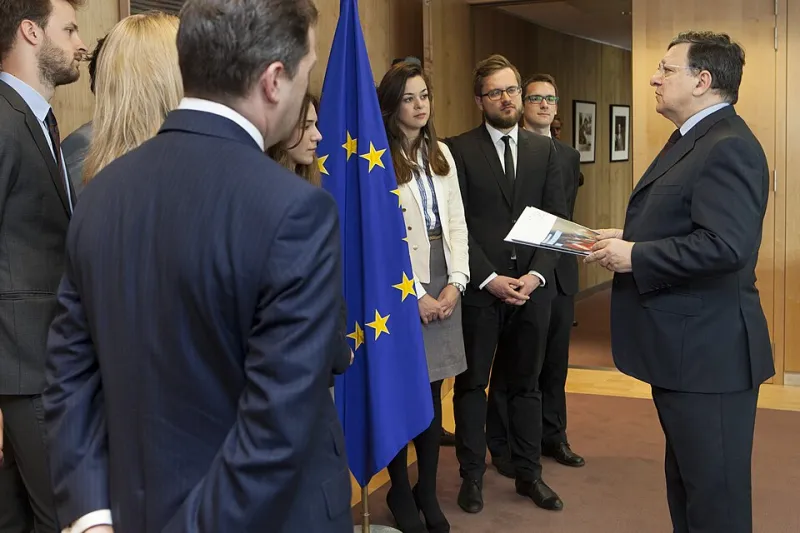
Photo: © European Union, 2014, CC BY 4.0, via Wikimedia Commons
Written questions rarely make the evening news. They do not carry the drama of a plenary vote or the menace of a confidence motion. Yet for UKIP's MEPs between 2014 and 2020, the European Commission's question-and-answer process became one of the most persistent instruments in a deliberately disruptive political repertoire. The paper trail they left behind is not a footnote to the UKIP MEP era. It is a record of how the party tried to turn procedure into publicity.
A procedural tool with a political purpose
Under the European Parliament's Rules of Procedure, MEPs can table written questions to the Commission and the Council. The answers are published, translated and archived. The mechanism is designed for scrutiny: a member asks for facts, figures or legal clarification, and an institution replies on the record. For a party that presented the EU as remote and unaccountable, that format had an obvious appeal. A question could be framed to expose a perceived absurdity, while the answer—however dry—could be cited as evidence that the institutions were evasive.
The UKIP cohort did not invent this technique. Eurosceptic MEPs from several member states had long used questions to probe EU competence. What distinguished UKIP's approach was its rhythm and reach. Questions were not confined to committee specialists. They were used by the party's front-rank campaigners, by MEPs with coastal constituencies and by newer members seeking a distinctive local voice. The result was a scattered but recognisable body of enquiries that mapped the party's priorities more candidly than many of its manifestos.
The subjects that recur
Three themes dominate. The first is fisheries. UKIP MEPs repeatedly pressed the Commission on quota allocation, the landing obligation, scientific advice and the treatment of small-scale fleets. Questions often asked for member-state-by-member-state data, or for the Commission's view on the impact of conservation measures on particular ports. This was partly constituency work—fishing communities were a natural UKIP audience—and partly a broader argument about who decides. The Common Fisheries Policy was presented not simply as a bad policy but as a case study in distant government.
The second theme is immigration and free movement. UKIP MEPs asked about border agency operations, asylum rules, access to benefits and the interpretation of free-movement law. The questions were often technical, but their purpose was political: to force the Commission to state, in writing, what EU rules required. Each answer could then be folded into the party's domestic argument that control had been surrendered.
The third theme is money. EU spending, audit findings, programme administration and parliamentary allowances all featured. Some enquiries were broad—asking how structural funds were monitored—while others were narrowly focused on particular projects or payments. The common thread was accountability: who signed off, who checked, and what happened when funds were misspent.
A cohort with different styles
The written-question record also reveals a cohort that was less monolithic than its public image. Some MEPs used questions as an extension of campaigning, choosing subjects that could be turned quickly into press releases. Others built up specialist dossiers, returning to the same policy area with incremental enquiries. A third group used questions to serve local constituents and regional media, asking about ports, farms or regeneration projects in their electoral regions.
That diversity matters for how we assess UKIP's European strategy. The party is often remembered as a single-issue insurgency. Its questions show a more varied operation: campaigners, committee technicians and constituency-minded representatives working in parallel, sometimes pulling in different directions.
What the answers did—and did not do
It would be wrong to claim that written questions changed EU law. They rarely did. Commission replies were often legalistic, partial or simply restated existing policy. But the value of the paper trail lay elsewhere. It created a searchable record, gave journalists and activists quotable material, and allowed UKIP to argue that the institutions had been asked a direct question and had failed to answer it.
There were limits. Questions could become repetitive. A scattergun approach risked looking like noise rather than scrutiny. And because the Commission controls the terms of its reply, a poorly framed question could produce an answer that undermined the questioner's point. The most effective UKIP enquiries were narrow, factual and difficult to dismiss; the least effective were rhetorical and easily absorbed by the institution.
The archive's afterlife
In 2026, the UKIP MEP era is over, but the questions remain. For historians of the period, they offer a granular view of what the party was doing between election campaigns. For anyone studying Euroscepticism, they show how procedural tools can be used as a megaphone: not to legislate, but to frame, repeat and legitimise an argument.
The Commission's inbox was never going to deliver Brexit. It did, however, preserve a running commentary on how UKIP's MEPs saw the EU—and on how patiently they were prepared to press their case, one written question at a time.