Bedfellows in Brussels: How UKIP's EFDD Group Rose, Ruled and Ruptured
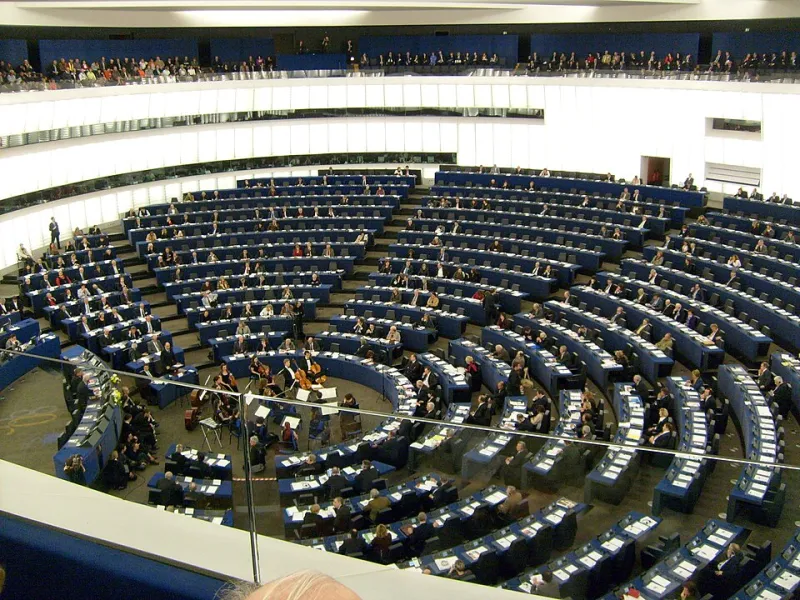
Photo: inyucho, CC BY 2.0, via Wikimedia Commons
European Parliament groups are often described as families. In practice they are coalitions of convenience, bound by standing orders and a shared appetite for speaking time. For UKIP's MEPs, the question of which family to join was never merely administrative. It shaped what they could say, what they could fund and how they were reported. The archive's files on the Europe of Freedom and Democracy group, and its successor, the Europe of Freedom and Direct Democracy, offer a case study in the gains and costs of awkward alliances.
From EFD to EFDD: A Group Built for Opposition
The Europe of Freedom and Democracy group emerged after the 2009 European elections as a home for parties sceptical of deeper integration. UKIP was central to it. Five years later, after the party's breakthrough in the 2014 European elections, the group was reconstituted as the Europe of Freedom and Direct Democracy. The change of name mattered less than the arithmetic. To secure group status, a political group needed at least 25 MEPs drawn from at least seven member states. That threshold encouraged UKIP to look beyond its natural sympathies.
The EFDD brought together UKIP, Italy's Five Star Movement and the Sweden Democrats, among others. It was united more by hostility to the Brussels consensus than by a common programme. On some questions, that was enough. On others, it was not. The archive's press cuttings from 2014 and 2015 show a group that could agree on the language of opposition but struggled to agree on what should replace the things it opposed.
The Standing Orders Test
Group rules are not neutral. They determine committee places, speaking slots and the allocation of staff and resources. They also impose a measure of collective discipline. A group that cannot hold together on procedural votes risks losing the recognition that makes it useful. UKIP's MEPs understood this. The archive contains internal notes and public statements from the period that treat group membership as a practical instrument rather than a statement of ideological kinship.
That pragmatism had limits. The EFDD's membership included parties with sharply different views on Russia, civil liberties and the role of the state. UKIP's own delegation was not homogeneous either. The result was a grouping that could function as a platform for Brexit arguments but was less effective as a legislative bloc.
What the Roll-Call Data Shows
Roll-call records in the archive show that UKIP's MEPs were a relatively cohesive delegation inside the EFDD. On budgetary restraint, opposition to deeper integration and the terms of the UK's departure, they voted together far more often than they split. The group as a whole was less disciplined. On foreign policy and civil liberties, EFDD members diverged sharply, and UKIP was sometimes left defending a group line it had not authored.
Cohesion data should be read with care. A high voting similarity score can reflect a shared opposition rather than a shared programme. The EFDD's scores were consistently below those of the large established groups. That is not surprising. The group was designed to disrupt, not to govern. The relevant question for UKIP's archive is whether disruption delivered enough visibility to justify the associations it required.
The Price of Recognition
Archived speeches return repeatedly to two themes: the group as a platform and the group as a liability. MEPs used EFDD speaking slots to put Brexit arguments on the record and to challenge the European Commission and Council. Group status gave them access to committee work and to the formal machinery of the Parliament. It also gave their opponents an easy line of attack. Association with controversial partners was used to suggest that UKIP's euroscepticism sat alongside views that mainstream British voters would reject.
That tension was never fully resolved. UKIP's MEPs could claim they were using the group, not endorsing every ally. Critics could reply that group politics is a collective enterprise and that the company a party keeps in Brussels matters. Both claims contain some truth. The archive's evidence suggests that the EFDD was most effective when it amplified a clear UKIP message and least effective when it forced the party to defend positions it had not chosen.
The Unravelling
The unravelling was gradual. Defections and expulsions reduced the UKIP delegation during the 2015-2019 Parliament. Key partners drifted away. The group's cohesion weakened as its membership changed. By the time of the 2019 European elections, the EFDD had ceased to be a functioning vehicle for UKIP's MEPs. The election itself ended UKIP's presence in the European Parliament, and with it the immediate reason for the group's existence.
The collapse was not a single event. It was the cumulative result of arithmetic, personality and political change. The archive's files show that the group had always been vulnerable to the departure of a few member parties. Its threshold was low enough to allow entry but high enough to make exit dangerous. UKIP discovered that a group built for opposition is difficult to sustain once the opposition has achieved its central objective.
Lessons for 2026
Twelve years after the EFDD's formation, the debate about UKIP's European Parliament era remains live. The group gave UKIP's MEPs a platform and a measure of institutional power. It also exposed them to the costs of awkward bedfellows. The archive does not need to settle whether the trade was worth it. It needs to document what was gained, what was lost and how the choices were made. On that record, the EFDD looks less like a family and more like a marriage of convenience that outlived its usefulness.