The English Channel: UKIP’s MEPs and the European Parliament’s Language Machine
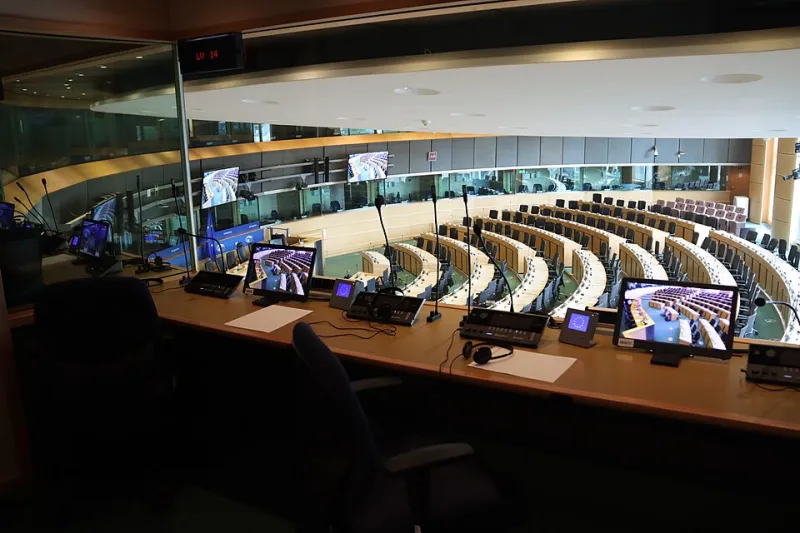
Photo: FrDr, CC BY-SA 4.0, via Wikimedia Commons
The European Parliament is often described as a legislature of 24 official languages, but that phrase understates the machinery behind it. Every plenary speech, committee exchange and voting list passes through a layered system of interpretation, translation and transcription. For UKIP’s MEPs between 2014 and 2020, that system was never merely administrative. It was a stage, a barrier and, at times, a political instrument.
A Parliament Built on Translation
UKIP entered the European Parliament in 2014 with a large cohort and a clear rhetorical target: Brussels as distant, costly and opaque. The Parliament’s multilingualism fitted that argument neatly. Interpretation booths, relay languages and translated documents could be presented as the visible cost of a political class detached from ordinary voters. Yet the same machinery also gave UKIP’s MEPs something they needed: a hearing. A speech delivered in English in Strasbourg could reach Finnish, French, Polish and Portuguese audiences within seconds. The party’s message travelled through the very system its speakers often criticised.
That tension is central to the UKIP MEP era. Language was not simply a practical question of who could understand whom. It was part of the party’s broader argument about legitimacy, bureaucracy and national identity. The archive record shows a party that used English as its natural medium while treating the Parliament’s translation apparatus as evidence of institutional excess.
English-Only as Political Theatre
Many UKIP MEPs spoke in English in plenary. That was unsurprising for a British party, but it was also a choice with performative value. An English-only speech in a multilingual chamber can signal directness, national difference or refusal to play the Brussels game. It can also limit reach. MEPs who relied entirely on interpretation depended on interpreters to carry tone as well as content. Sarcasm, irony and colloquial British references do not always survive the booth intact.
The result was a mixed record. Some UKIP speeches translated well because their argument was blunt and declarative. Others lost force in relay. The Parliament’s interpreters were professionals, not political allies or opponents, but their presence inevitably shaped how UKIP’s message was received. A speech designed for a British audience could sound different in French or German. The party that often claimed to speak plainly for ordinary people was, in Strasbourg, speaking through a filter.
The Archive in Translation
For researchers, the language question leaves traces in unexpected places. Voting records are largely numerical, but the surrounding documents are not. Committee minutes, amendments, written questions and plenary transcripts all pass through translation. The English version held in the archive may be the original, a translation or a revised text. That matters when trying to reconstruct what was said and what was meant.
UKIP’s written questions to the Commission are a useful example. A question drafted in English about fisheries, state aid or the eurozone could be published in every official language. The argument might be sharp in English and flatter in translation. The archive user sees the final text, not the drafting process. The same applies to committee minutes, where interventions are summarised and translated. The record is real, but it is not a recording. It is a curated multilingual document.
Committee Minutes and the Limits of the Record
In committee, the language regime was more intimate and more technical. MEPs could switch languages, request interpretation or rely on colleagues. UKIP’s committee members often worked in English, but they did not work in isolation. Officials, rapporteurs and other MEPs moved between languages constantly. The committee room was less a Tower of Babel than a workplace with a complex division of linguistic labour.
That setting makes the UKIP record harder to read than plenary theatrics. A short intervention in committee might appear in minutes as a single translated sentence. The tone, the interruption, the exchange with the chair — these are largely lost. For a party that often framed Brussels as remote, the committee minutes offer a counter-record: mundane, technical and multilingual. They show UKIP MEPs engaging with the machinery rather than only denouncing it.
What Westminster Can Learn in 2026
The language question has returned to British politics in 2026, as Westminster debates the cost and politics of translation in public institutions. The arguments are not identical to those in Strasbourg, but the underlying tensions are familiar. Translation is expensive. It is also a condition of democratic access. A public body can waste money on unnecessary duplication, and it can also exclude people by refusing to translate. The difficult question is where the line falls.
UKIP’s European Parliament years offer a case study in that ambiguity. The party’s MEPs often attacked the cost of multilingualism while benefiting from its reach. They spoke in English and were interpreted into 23 other languages. They criticised the Brussels machine and used its distribution system. That is not simple hypocrisy; it is the ordinary condition of representative politics in a multilingual institution. The archive does not resolve the argument. It shows how the argument was performed.
The Booth as a Political Space
Interpreters are rarely named in political histories, but they are part of the institutional story. In Strasbourg, the booth was a political space in its own right: a place where meaning was transferred, adjusted and sometimes stretched. For UKIP’s MEPs, the booth was both an enabler and a symbol. It allowed a British party to speak to a European chamber. It also made that speech dependent on intermediaries.
The UKIP MEPs Archive holds the written traces of that arrangement. The speeches, questions and minutes are there, but the voices in the booth are not. Reading the record in 2026 requires an awareness of what translation added and what it removed. The English Channel was never just a stretch of water. In the European Parliament, it was also a linguistic route — monitored, interpreted and archived.