The Map That Made the MEPs: Five 2014 Results That Built UKIP's European Breakthrough
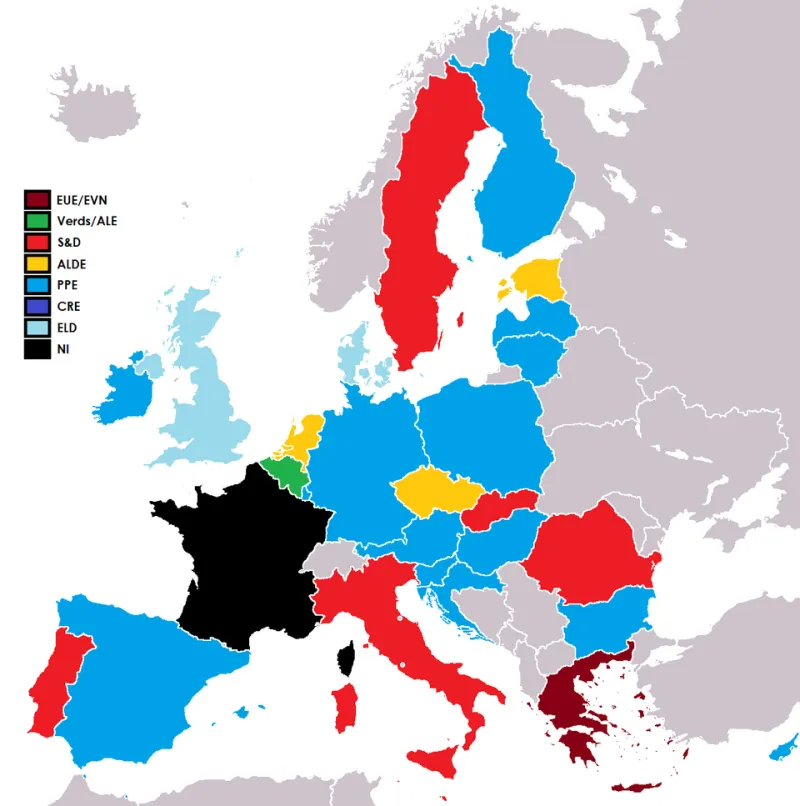
Photo: Leptictidium, CC BY-SA 3.0, via Wikimedia Commons
European elections are often treated as a national opinion poll with seats attached. The 2014 contest was different. UKIP finished first with 27.5 per cent of the vote and 24 MEPs, displacing the Conservatives and Labour in a national contest. Twelve years later, in 2026, the result is history, but the map still repays attention. It shows where the party's support was concentrated, which local stories carried it and why a European breakthrough did not translate smoothly into Westminster power.
1. South East: the leader's bridgehead
The South East was the headline. Nigel Farage headed the regional list and UKIP returned four MEPs, the largest UKIP bloc in any region. The result was built across Kent, Sussex, Hampshire and the Thames Valley rather than in a single heartland. Fishing ports and coastal towns gave the campaign its imagery; suburban and small-town voters gave it the numbers.
For UKIP, the South East mattered symbolically as well as arithmetically. It was the region where the party's leader could present himself as a national figure with a regional base. The victory also created an expectation: that UKIP could convert European votes into Westminster seats. In 2015 the party would win only one constituency seat, a reminder that the European map and the Westminster map were not the same.
2. East of England: three seats and a coast-to-country bridge
UKIP took three seats in the East of England, with Stuart Agnew, Patrick O'Flynn and Tim Aker elected. The region stretched from the Lincolnshire fens to Essex and Norfolk, and the party's vote drew on farming areas, coastal towns and commuter districts. Boston and Skegness, Great Yarmouth and Clacton were among the places where UKIP's message about immigration, fishing and distant government found a ready audience.
The East of England result was important because it was not simply a protest in one city. It was a regional spread, linking agricultural discontent with concerns about local services and migration. That breadth helped UKIP claim it was becoming a national party rather than a collection of local revolts.
3. South West: two seats in Liberal Democrat country
The South West returned two UKIP MEPs, William Dartmouth and Julia Reid. The region had been a Liberal Democrat stronghold in European elections, and UKIP's success there signalled that the party could compete in rural and small-town England beyond its Essex and Kent stereotypes. Cornwall, Devon and Somerset provided the local colour: fishing communities, market towns and voters who felt overlooked by distant institutions.
The South West also illustrated a tension in UKIP's appeal. It won votes from former Conservatives and former Liberal Democrats, from Eurosceptics and from people mainly interested in local services. Holding that coalition together would prove difficult once the European election was over.
4. North East: one seat in Labour's heartland
The North East elected Jonathan Arnott, giving UKIP a single MEP in a region dominated by Labour. The result was striking because it cut against the idea that UKIP was purely a southern English phenomenon. Sunderland, Middlesbrough and Hartlepool had long traditions of Labour voting, but UKIP's vote showed that European elections could loosen those ties.
The North East victory was thin in seat terms—one MEP—but thick in meaning. It allowed UKIP to argue that its appeal crossed the north-south divide and that Labour's heartlands were not immune to its message. In 2026, with the benefit of hindsight, the result looks like an early warning of the realignment that would reshape British politics later in the decade.
5. Scotland: a single seat and a symbolic breakthrough
Scotland returned David Coburn as a UKIP MEP, a result that was symbolic far beyond its single seat. UKIP had no Scottish parliamentary representation and limited local government base, yet it won a European seat in a country where the constitutional debate was dominated by independence. The campaign drew on unionist sentiment, fishing communities and voters opposed to the EU's fisheries and regulatory regime.
The Scottish result was also a reminder of the limits of the breakthrough. One MEP in a proportional system was not a durable party organisation. It gave UKIP a platform, but not the local infrastructure needed to sustain it.
What the map meant
Taken together, the five results show a party advancing on several fronts at once: the south coast, the east coast, the rural south-west, the industrial north-east and Scotland. The 2014 map was broad enough to sustain the claim that UKIP had become a national force. It was also shallow enough to hide the organisational weaknesses that would become clearer after the referendum.
In 2026, the UKIP MEP era is closed. The 2014 map remains a useful historical document—not because it predicted everything that followed, but because it captures the moment when a European election became a domestic earthquake.