Sixty Seconds on the Floor: UKIP’s MEPs and the Tactics of Brevity
Photo: © Communautés européennes 1997 - EP, European Parliament, via Wikimedia Commons
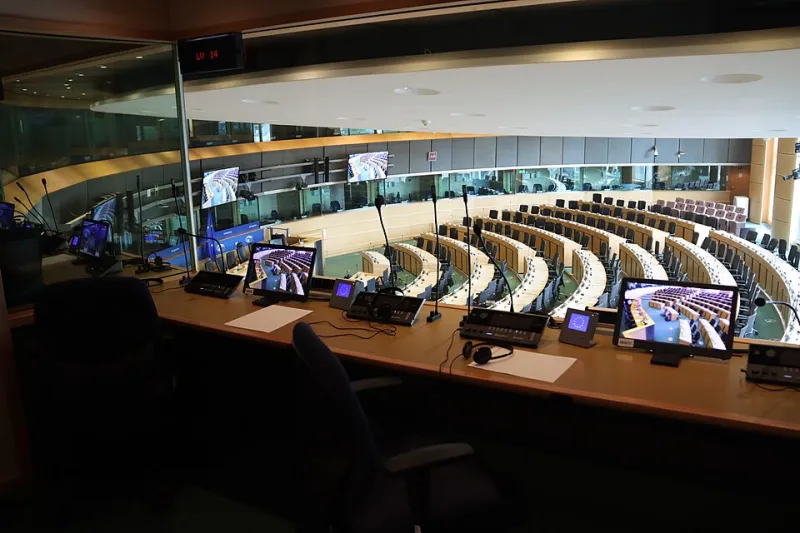
Sixty seconds is not much time in a chamber that can devote hours to a single amendment. Yet the European Parliament’s shortest speaking slots became one of the most recognisable stages for UKIP’s MEPs. The party’s European parliamentary era, from 2014 to 2020, is often remembered through set-piece speeches and viral clips. The archive record suggests a more granular story: a small procedural opening, used repeatedly and deliberately, that allowed UKIP to speak past the committee room and directly into the political conversation back home.
A Small Opening in a Crowded Order Paper
One-minute speeches usually come at fixed points in the parliamentary timetable, while catch-the-eye contributions depend on the chair’s discretion during a debate. Neither route offers legislative power in the ordinary sense. A member cannot amend a text, summon a commissioner or bind a vote in sixty seconds. The value of the slot lies elsewhere: it is short enough to travel, direct enough to feel unmediated and flexible enough to carry a party’s core message without the burden of detailed committee scrutiny.
For UKIP, that combination was useful. The party’s MEPs were never numerous enough to dominate committees or shape rapporteur reports. But they could queue, prepare and compress an argument into a form that fitted the chamber’s rhythms. The archive footage shows a recurring discipline: a claim, a quick example, a sharp conclusion. Sometimes the target was the European Commission; sometimes it was the British government; often it was the domestic audience that would see the clip later.
Patterns in the Archive
Across the 2014–2020 term, the recurring themes are familiar: fisheries policy, budget contributions, migration control, state sovereignty and the case for a referendum. What is striking in the archived debates is not the novelty of the arguments but their repetition and portability. A speech on the common fisheries policy could be delivered in Strasbourg and recycled in a coastal constituency. A passage on budget net contributions could be clipped for a party broadcast. A challenge to the chamber’s consensus could be framed as a challenge to Westminster’s elite as much as to Brussels.
Brevity imposed a style. Long historical passages were rare; technical detail was thinner than in committee. The strongest interventions were those that understood the format. They treated the minute as a funnel rather than a lecture: one idea, one illustration and one line that could survive editing. The weakest were those that tried to compress a full committee argument into a format that could not carry it.
The Floor as a Funnel
UKIP’s MEPs operated in a media environment that rewarded shareable moments. A sixty-second speech could be uploaded to a party website, circulated on social media and quoted by sympathetic outlets long before the Parliament’s official record appeared. That did not make the speech legislatively important, but it made it politically useful. The floor of the European Parliament became a production line for content that could be consumed in Britain without the context of the chamber.
This was a rational response to limited institutional power. A party with few committee chairmanships and no place in the Parliament’s governing majority could still generate visibility. The short speech did not require a coalition, a rapporteur’s file or a compromise amendment. It required timing, a clear message and an eye for the camera. In that sense, the tactic was less a bypass of committee scrutiny than a decision to compete on a different terrain.
Did It Disrupt the Consensus?
The honest answer is: less than the clips implied. The European Parliament’s majorities on budget, fisheries and regulatory files were not seriously unsettled by brief denunciations from the benches. Votes were not shifted because a UKIP MEP had delivered a memorable minute. The chamber’s consensus was durable, and UKIP’s small group could irritate it more easily than it could alter it.
But disruption is not only measured in whipped votes. The short speech helped set terms of debate, supplied footage to a wider Eurosceptic ecosystem and normalised arguments that had once been confined to the margins. It also exposed a representational gap: an MEP could be highly visible without being powerful. That gap was both a weakness and a resource. It allowed UKIP to claim it was speaking for voters against a distant institution, while the institution’s procedures remained largely untouched.
Catch-the-Eye and the Limits of Theatre
Catch-the-eye debates added a more unpredictable element. The format depends on the chair, the balance of political groups and the mood of the chamber. UKIP MEPs could find themselves called late, cut short or passed over. When they were called, the direct exchanges could be sharper than a prepared one-minute speech, but they could also make the party look marginal if the room did not respond.
The archive record suggests that the tactic worked best when it was treated as communication rather than legislation. The speeches that endure are not the ones that changed a text. They are the ones that captured a mood, framed a grievance or gave a campaign a usable line. That is a real form of influence, but it is not the same as parliamentary power. The distinction matters for anyone assessing UKIP’s European years.
What the Record Cannot Show
The archive has its own bias. Speeches are preserved; the quieter work of committees, amendments and constituency casework is less visible. A study of one-minute interventions therefore risks overstating their importance. The fuller picture requires comparison with voting records, committee attendance and the wider party record. The short speech was one tactic among many, not the whole strategy.
In 2026, with the UK no longer represented in the European Parliament, these brief interventions are best read as artefacts of a particular political moment. They show a party adapting to the rules of an institution it opposed, using its smallest openings to maximum effect. They also show the limits of that adaptation. UKIP’s MEPs could command a minute, and sometimes a news cycle, but they could not command the chamber.
Sixty seconds, well used, can travel a long way. It cannot, by itself, change a treaty, a budget or a vote. The art of the short speech was real, and UKIP’s MEPs practised it with discipline. But the record suggests that its lasting impact lay in the argument it amplified, not in the institution it disrupted.