Taking Brussels to Its Own Referee: UKIP's MEPs and the Ombudsman Route
Photo: © Communautés européennes 1997 - EP, Attribution, via Wikimedia Commons
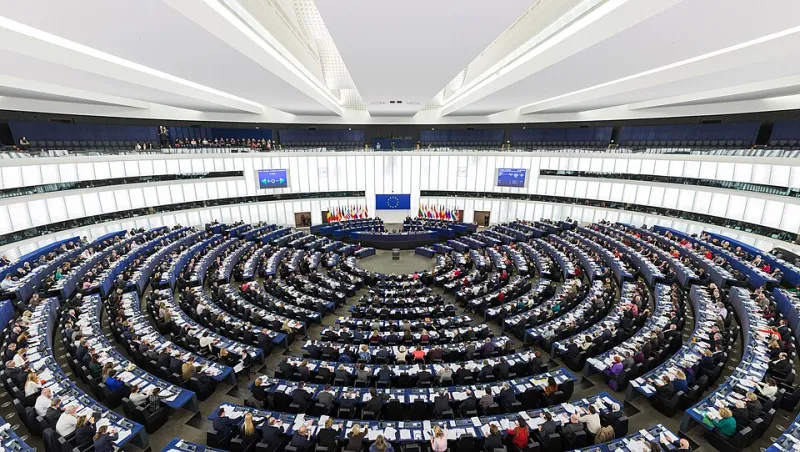
Of all the institutions UKIP's MEPs met during the 2014–2019 Parliament, the European Ombudsman was the least theatrical. There was no chamber, no voting board, no translator's booth. There was a complaint form, a case number, and an investigator in Brussels asking an institution to explain itself. For a group of politicians whose rhetoric turned on the claim that the EU could not be held to account, that quiet procedure was either the proof of the argument or the exception that tested it. The archive's files on the period, revisited now that the parliamentary term is long closed, suggest it was a mixture of both.
A Referee Without a Whistle
The Ombudsman's remit is narrow on paper and broad in practice. Any EU citizen, resident, or member of the European Parliament may complain about maladministration by an EU institution, body, office or agency. There is no fee and no need for a lawyer. The Ombudsman cannot bind an institution to a finding; she can investigate, issue draft recommendations, and publish a decision. Compliance is voluntary, though the reputational cost of refusal is real and the office publishes non-compliance.
That design suited MEPs with a grievance and a press office. A complaint cost a signature and a covering note. It produced a case reference from an independent office, a formal exchange of letters with the Commission or the Parliament, and — if the complainant chose — a document that could be quoted in a Strasbourg debate or a Westminster constituency meeting. For UKIP's MEPs, few procedural tools offered so much reach for so little outlay.
What Was Actually Alleged
Read together, the complaints lodged or publicly supported by UKIP's MEPs cluster around four subjects.
The first was access to documents. Successive UKIP MEPs pressed the Commission and the Council over refusals under Regulation 1049/2001, particularly where disclosure was resisted on grounds of ongoing decision-making or international relations. These complaints were rarely glamorous and frequently turned on the timing of a release rather than its principle, but they generated a paper trail of confirmatory applications that the archive has since catalogued. Fisheries files recur here, unsurprisingly given the party's emphasis on the Common Fisheries Policy.
The second was the transparency of informal trilogues, the closed meetings in which Parliament, Council and Commission settle legislative texts. The Ombudsman ran a own-initiative inquiry into the practice during the term, and MEPs from several groups — UKIP among them — used its findings to argue that the Parliament's formal readings had become ratification exercises. It is worth recording that this was not a distinctively eurosceptic complaint; Greens and others made the same case, often more persistently.
The third was the internal administration of the Parliament itself: allowances, expenses, the handling of requests for information about how members' money was spent. A party that campaigned on the EU's accounts found an obvious line of attack, and complaints about delay or refusal in answering such requests were a recurring feature of the correspondence.
The fourth was the movement of senior officials and office-holders into the private sector — the so-called revolving door. The Ombudsman's inquiry into the Commission's handling of a former Commission president's appointment to a senior banking role, opened in 2016, drew support from MEPs across the spectrum, including UKIP members who framed it as evidence of an institution regulating its own friends.
How the Institution Answered
Outcomes were unglamorous. The great majority of individual complaints ended in a decision of no maladministration, or were closed after the institution supplied the missing document or corrected the contested practice. A smaller number produced a friendly solution or a draft recommendation. Own-initiative inquiries, where the Ombudsman set the agenda herself, tended to yield more: guidance on trilogue documentation, recommendations on cooling-off periods for senior staff, published standards on the handling of access requests.
For UKIP's MEPs this produced a mixed record in the archive's reading. The complaints that succeeded tended to be small, procedural and specific — a document released, a delay explained, a practice altered. The complaints that promised the most rhetorically, alleging systemic bad faith, almost never secured a finding to match the language used in the accompanying press release.
From Case File to Campaign Material
The political use came after the decision, not before it. A no-maladministration finding could be characterised as the institution clearing itself, which was itself a serviceable line in a eurosceptic speech. A draft recommendation could be presented as a concession extracted. A refusal to comply — rare, but not unknown — was the best outcome of all.
The archive's correspondence shows the pattern clearly: a complaint lodged, a decision received, a press release issued within days, and a Strasbourg intervention or a constituency article following shortly after. Whether the Ombudsman's findings were accurately represented in those releases is a separate question, and the files allow readers to check. In several instances the gap between the decision's careful wording and the summary offered to supporters is wide enough to be instructive.
The Limits of the Route
Three structural features limited what the Ombudsman could deliver for any complainant, eurosceptic or otherwise. The office cannot rule on the legality of an act, only on the conduct of its administration. It cannot compel disclosure or reverse a decision. And it works at a pace that rarely matches a political news cycle: a case opened in the autumn might conclude after the following summer, by which time the debate that prompted it has moved on.
There is a further limitation that the archive's material makes plain. UKIP's MEPs were most effective as complainants when they worked alongside MEPs from other groups, sharing evidence and reinforcing a case that had already been assembled by someone else. The lone-complainant model produced headlines; the collaborative model produced changes in practice.
Why the Files Still Matter in 2026
The Ombudsman's office has since changed hands — Teresa Anjinho took over in 2025 — and the Parliament that received these complaints no longer contains any UKIP members. The case files, however, remain public and cumulative. They are among the few places where the party's allegations about EU administration were tested against an evidence standard by an institution with access to the relevant documents.
That makes them a useful corrective in both directions. They undercut the claim that the EU's internal review mechanisms were wholly inert: documents were released, practices were revised, and officials were questioned on the record. They also undercut the claim that the Ombudsman offered UKIP's MEPs a decisive weapon: the yield, measured in findings, was modest, and the loudest complaints were the least successful.
A Referee, Not a Verdict
The honest conclusion for the archive is that the Ombudsman route was both things at once. It was a real avenue of accountability, used seriously by some UKIP MEPs on some files, and it was a reliable source of quotations for a party that treated every procedural exchange as evidence for the wider case. The two uses were not always separable, and the individuals involved were not always consistent about which they were pursuing.
What the files do not support is the simplest version of either story. The Ombudsman was never the EU's conscience, and never merely a stage prop. She was a referee who kept notes — and in 2026 those notes are still worth reading.